


Slow Thinking Tools
Analogue exercises for half-baked ideas
Welcome!
Here, we’ve brought together some of the thinking tools we teach in our thinking skills training workshops. We hope they help provide a bit of structure as you think through challenges, decisions and projects. But the tools in this resource are not magic. They are designed to help you focus, analyse your ideas, and check your thinking. Remember, you stopping to think through things that matter to you, your life and your work – that’s the real aim.
Step 1: Pay Attention
Thinking doesn’t get started without attention. Maybe that’s why the French philosopher, Rene Descartes, said he was going to lock himself in his room until he could work out what he could really know for sure. (By the way, it was during that time that he came up with his ‘I think, therefore I am’ idea.)
To begin, let’s make some space to think. Try this…
Sit or stand comfortably. Close your eyes, and take a couple deep breaths. Next, beginning at the top of your head, start mentally scanning through your body. Notice what you find. Don’t judge it. Just notice it. Next, do a similar scan, but this time scan through your emotions. Are you excited? Anxious? Calm? Afraid? Again, just notice what you find. By doing this short check-in exercise we are reminding ourselves that we are not just minds connected to computers. We are embodied thinkers who often feel their way to insights. Pausing to check in with your body and emotions in this way can help you slow down and make space to think your best.
If you noticed anything particularly interesting when you were doing your short scan exercise, make a note of it.
Step 2: Think Systematically
The Roman Emperor and Stoic philosopher, Marcus Aurelius said that, “nothing has such power to broaden the mind as the ability to investigate systematically and truly all that comes under thy observation in life.” If it was good enough for an emperor navigating complex politics and wars, it’s good enough for us. So, try this approach to help you think systematically.
Bring to mind a decision, challenge or project you’d like to think through. Take a couple minutes and ask yourself, ‘What’s the big idea?’. Stepping back mentally, what is this thing you’re considering really about?
Don’t worry about finding THE one and only perfect answer. But if you get a sense that you’re on to something, write down what you think the big idea about your thinking task.
Next, ask yourself: ‘What are the top 5 or 6 main areas of this thing I’m thinking about?’. The areas could be steps in a project, or they might be key aspects of a decision. Or they might just be main concerns that are important to you about the thing you’re pondering. As you identify them write them down in list form.
Now, zoom into each of those 5 or 6 areas and consider what each area is really about. For example, if you’re trying to decide how best to grow your team, one big idea might be supporting their career development. Then when you dig into the details of that big idea you might identify that that issue is made up of smaller points about changes in your industry, expectations of team members, and insecurity in the job market. With this step, you’re trying to really get to know your challenge at a granular level. As you think through each area of your challenge, write down the different things making up the challenge.
Step 3: Find Your Agency
Thinking is valuable in it’s own right. But often thinking is important because of actions we want to take. We want to make the right decision, articulate our view with clarity, or perhaps respond strategically to something we’ve encountered. In this third step, we’re going to remind ourselves that we have agency (i.e. choice). In the philosophy of what it means to be a person, agency is a big deal. The fact that we have choice is part of what makes us the kinds of beings we are. It’s also part of the reason we can be held responsible for our actions. When you’re thinking through things, it’s important to remember that you have choice and your thinking should inform good action.
So, take a look at all the things you’ve noted down. We’re going to think like a Stoic philosopher now. The ancient Greek stoics we’re big on trying to work out what you could control and what you just had to accept. Reading through your notes, is there anything you would say you can control? If so, write a little ‘c’ next to that thing. Are there things you can’t control, but you could influence? If you find such things, write a little ‘i’ next to those items. Lastly, where are there things that you can neither control, nor influence, but which you just might need to accept? If you spot any of those, write a little ‘a’ next to those aspects of the thing you’re thinking through. Hopefully, thinking through your task in this way will have shown you some places where you have choice and can keep moving forward.
Step 4: Act
At Philosophy at Work, we like to say ‘think better. do better.’. Baked into this little phrase is the idea that if you think better you’ll do better. Now, what action might you take based on your thinking? Take a moment, to consider, and then write down your next step.
We hope this 4-step process proves helpful to you. If you’d like to find out more about the thinking skills workshops Philosophy at Work delivers in businesses, start a conversation with us here.
Further reading
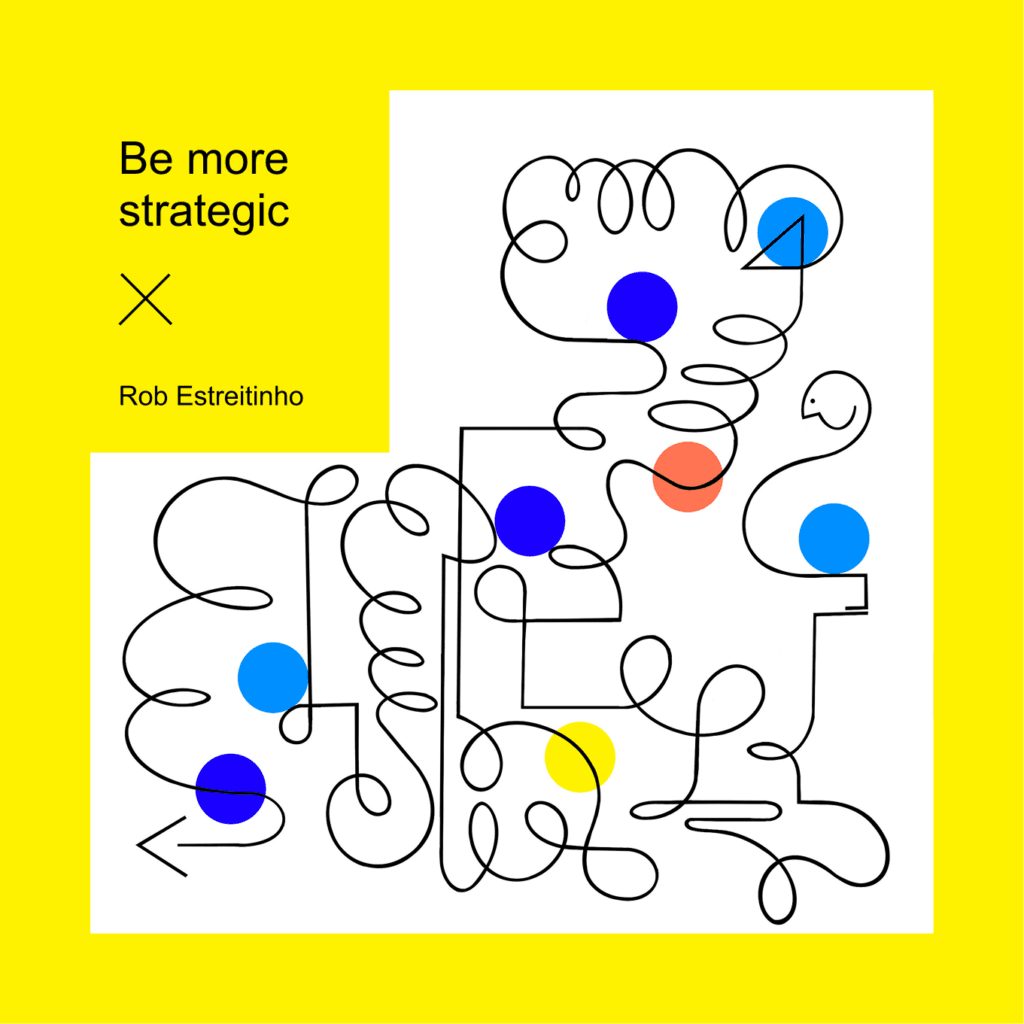
Be more strategic
Swimming upstream with strategy veteran and Salmon Labs founder, Rob Estreitinho. Dr. Brennan Jacoby and Rob discuss all things strategic thinking.

7 Areas Where Philosophers Will be Needed
We are now in an era of hyper-change. This is called the Great Acceleration. So what happens when things are shaking?


