Dr. Brennan Jacoby spoke with Jess Majekodunmi and Dan Kiernan about the skills needed when bringing AI into your professional practice. The conversation considered the hopes and fears surrounding AI and the future of work, but most of all curiosity and critical thought shown through. The text below shares key themes and snippets from that conversation
Note: We asked bots to capture what the key points were from the conversation. But we disagreed with the tech. The themes shared below are not what the bots came up with. They’re points that we thought were more important. If you’re curious to see what you would have spotted as key takeaways for your own career at this pivotal moment in the history of work, you can listen to the full, unedited conversation here.
In Conversation:
BRENNAN: Tool or terror – How do you see AI?
JESS: I think it’s both. History tells us that most technologies do good and bad and would do both at the same time…A fire can warm our homes, but it can also burn them down. It might seem a complete cop out to say ‘both’, but I think it genuinely is. We are talking about technologies that learn and grow and build. The more we do things that are negative, the more they get ingrained within the design and the values of that technology itself. I think it’s about leaning in and trying to do as much as possible in the more positive aspects of the tech.
DAN: As long as we work in a capitalist society, speed and efficiency are incentivised. That can squeeze workers, and that can be very dehumanizing. Taking steps to mitigate against this, and instead trying to make the workplace more human is often counterintuitive within a business where incentives are all around speed and profitability. But that move is important to AI being a tool and not a terror.
BRENNAN: Making the most of AI, then, is not just about how we manage our relationship with it, but also how we are helping ‘raise’ it – if I can use that language. So, what do we do to ‘raise’ AI well? How can we use this kind of tech without reducing ourselves?
DAN: It’s fine to be using AI to speed things up, but the skill is going to be in spotting when AI is not going to be that helpful or where using AI is actually diminishing your opportunity to learn something or be more creative or add some additional value.
BRENNAN: What would you say defines when AI isn’t helpful or when it might diminish us?
DAN: I remember years ago reading the management guru Peter Drucker. He said that for knowledge workers the key skill is going to be figuring out what to do – what should the priorities be, and what should I work on today? I think this is a similar sort of challenge. The key challenge is figuring out whether what you’re working on is a job for AI or if it’s this a job for you.
JESS: I hear a lot of statements like, ‘if we can automate all these tasks, workers can be more strategic or be more creative’. And I do have to pause and go, really? Because perhaps what it looks like for me to be strategic and creative is staring out the window and letting my mind float and think of things. If I was to do that in most workplaces, most managers wouldn’t recognize that as me being productive or effective. And I can’t just turn around and say, ‘oh, it’s okay, the AI is doing it all. I’m being strategic and creative over here. This is my value’. I think we really need to not let those statements go without interrogation. I’m a design historian at heart. So, in terms of the human sciences, my thing is design – design history. If we look at the introduction of technology where we’re meant to be saving time, the really classic example from that world is around technology in the domestic setting – washing machines and so on. They tended to add more work – not reduce work. There’s an incredible book called More Work for Mother that shows that the introduction of the washing machine meant that we wash more things. It changed the design of our clothing. We didn’t have detachable collars and cuffs anymore. We also dropped our tolerance for smelly people. The world was a much smellier place. So, actually history suggests that we won’t have extra time. We will just fill that time with more work.
BRENNAN: So, we need to critically engage with claims about efficiency and value adding. But I also hear you making a point about culture. If your boss doesn’t think you’re adding value when you’re looking out the window, isn’t that a problem of culture? If tech is doing our busy work, then perhaps we just need to shift how leaders understand what it looks like to add value.
JESS: I’m reminded of some research that we did at Accenture around optimal cognitive states for knowledge workers. While tedious work is one of the most obvious places for things to be automated, we found that ‘drudge work’ plays a really valuable role in how our brains flow through our working days. And, actually, some of us really like that kind of work. It’s not very taxing, but you have to do it, and it enables a little bit of rest to happen. It’s really good when it follows periods of intense cognition. So, I think we also need to consider how we even think about work. I’m an office-based worker. But there are lots of other workplaces. For example, there are people driving buses, and there are all sorts of industrial settings and fieldwork settings. It can be very different in those environments. Given the diversity of work, I think this idea of ‘higher value work’ can be limiting and, at times, perhaps patronizing to a whole group of workers.
BRENNAN: Extending the historical point Jess has made, do you think this evolution of AI is just the next big thing, and that we can extend lessons we’ve learned from past innovations, or do you think that this time is different?
DAN: Well, I do feel more anxious about this development, but I can’t figure out if that’s just because I’m older and a bit more set in my ways, or if it really is something different. It does seem perhaps not unprecedented, but the kind of development that only comes along very infrequently. So perhaps akin with the Industrial Revolution or the invention of the printing press. Of course, for all the benefits of the Industrial Revolution, there were a lot of disbenefits too. And for all the benefits of widespread literacy in Europe, we had the Thirty Years’ War as well. What we’re experiencing is not unprecedented, but it does feel like it could be something that really does turn our world upside down for a period.
JESS: I think it is hard to tell when you’re in it. And I don’t know whether it’ll be the internet or artificial intelligence that will be the thing that is named as the epoch defining technology. But one thing I’m very conscious of is that I can be in a bubble. I work in a big glass building that is an innovation centre. I’m a knowledge worker. I work for a company that is massively technologically optimistic. I read a lot of media around technology, so I can feel the same anxieties that Dan is expressing as well. But the spread of this innovation we’re talking about is really uneven. Globally there are still huge groups of people who have never been on the Internet. And so how this is actually spread out, and how it is just within major money markets – I worry about that. I worry about how uneven it is.
BRENNAN: I hear a lot of people saying that GenAI is learning from all the world’s knowledge, and on the one hand we could say there’s a lot of diversity of thought on the internet that AI is learning from, but to your point Jess, the education AI is receiving is not accurately reflecting the diversity of all humanity’s knowledge.
JESS: Yes. There are huge drives at the moment to try and digitize a lot of newspapers across the continent of Africa and to get historical archives created and digitized. There’s work going on in the States at the moment around some of the historically black colleges and also newspapers to also do similar things because otherwise we’re just missing out. It’s not inclusion for inclusion sake, we’re missing out on brilliance and excellence.
BRENNAN: So much of the discussion that I see happening about AI focuses on efficiency gains from the tech. And while efficiency can be valuable, it’s refreshing to me that our conversation has gone in the direction of talking about power, knowledge, inclusivity, and what really counts as the content that AI is digesting. That’s a huge field of research though. What big ideas do you think people should hold in the back of their minds as they’re navigating the use of AI in their work?
DAN: With my career advisor hat on, I think it’s spotting where AI can help you in your job, spotting the tools that can help with that, and then focusing on those tools. So, not trying to be abreast of everything that AI is capable of in every possible context and scenario, but picking two or three products that help you right now. Get good at those tools, and that will help you in your job. If your job changes, you can then pick the next three tools that help you do the next job and get good at those. Don’t try and boil the ocean. That’s just tactical careers advice to keep your job and keep yourself important and valuable in the workforce while we go through these changes.
JESS: Related to Dan’s point about picking two or three tools and reassessing which two or three tools you want to use as your career evolves is a practical point about calibration. Accenture did some really interesting work with MIT on a useful idea called calibrated trust. The ideas is that the trust you put in a system needs to match its capabilities. An example of over trust in tech is when, sat nav was first introduced to cars and people were driving into lakes because the voice told them to. That’s over trust. I think what we’re seeing now, particularly with a lot of the AI tools that change and evolve their capabilities over time is that you have to constantly calibrate how you assess those tools. I think we should continue assessing the appropriateness of the tools we’ve chosen as they change and we change. I’m also hearing a lot at the moment about AI literacy. Everyone wants to get literate in AI. I’m all for that as long as it is both technical and social literacy. It’s socio-technical literacy that I think is really critical. It’s not just about understanding how the technology works. It’s also about how that tech effects relationships with people, and how it effects workplaces.
BRENNAN: I love the balance of pragmatism and thoughtfulness involved in picking two or three tools to focus on but also engaging with those tools critically to assess the continued appropriateness of using them. We’re only really AI literate if we’re using the tech in ways that are intentional and thoughtful when it comes to task efficiency, but also power dynamics and inclusivity.
BRENNAN: Bringing our conversation in to land, is there a question that you would suggest people carry with them as they seek to engage with AI thoughtfully?
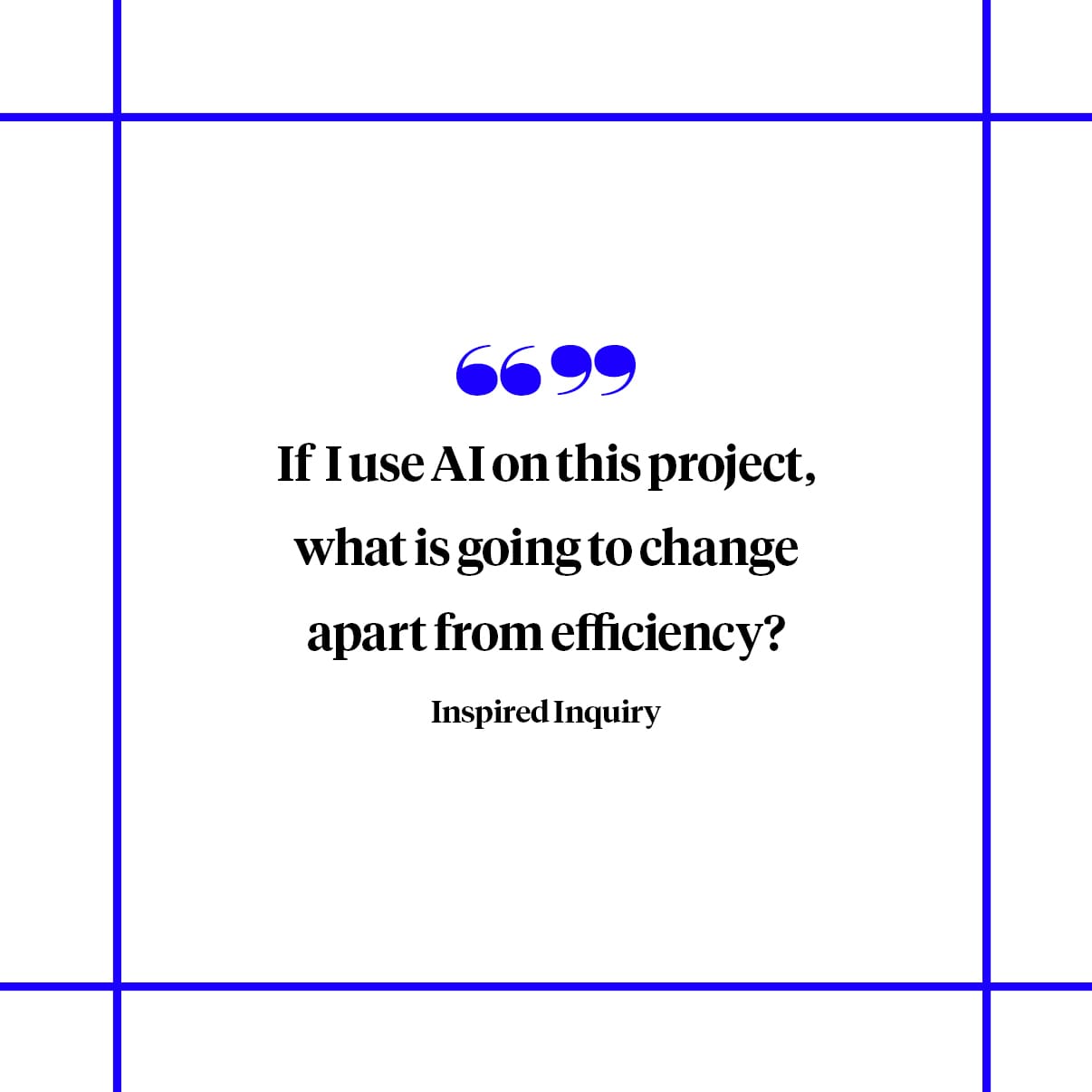
DAN: Anytime we’re looking at using AI, I think we should ask, “What’s this going to change apart from speeding things up?”. There’s an unspoken assumption that anything that adds to efficiency must be good. But, as we’ve highlighted in this conversation, that’s not necessarily true. So, what else will this change other than just speeding things up?
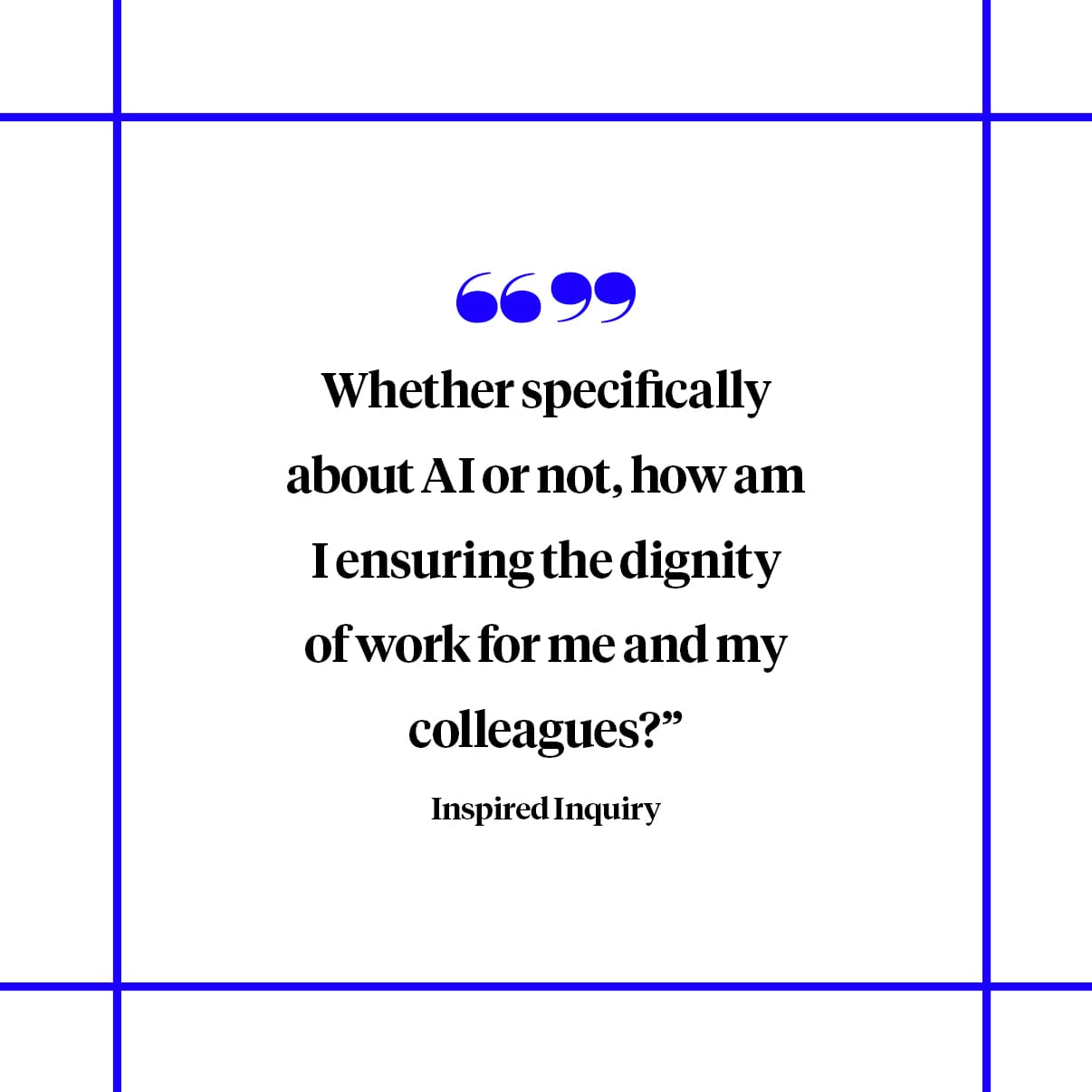
JESS: Great question. I do a lot of work with senior leaders in large companies who are often asking me whether people will adopt technology. In those conversations, one of the things I find myself trying to open up conversations about is this question: “How are you ensuring the dignity of work for your people?”. There has been a very strong sense of dignity of work under pressure at the moment. And I know this is not new. From Confucius to Carlisle to religious texts and political activists, dignity of workers is not a new concept. But dignity is very much under pressure right now. There is a sense that people are being monitored and that a sense of autonomy is being removed. This impact on dignity is having massive implications to people’s motivation, satisfaction and fulfilment in work. That’s particularly under pressure when you think about generative AI co-pilots and agents being pitched at us as collaborative and creative colleagues. So, the question I’d suggest is, “How within all of that are you thinking about the dignity of work for your people?”.
BRENNAN: If I’m a senior leader, then, I should be asking how the way my business engages with AI is impacting beyond just efficiency, and crucially, how our use of AI is impacting the dignity of workers within the organisation. It strikes me, though, that the questions you both shared apply to roles throughout organisations. If I’m a member of the team that’s not in a senior leadership role, it might still be good for me to consider how my engagement with technology impacts on how I view myself.
BRENNAN: Thank you both again very much for sharing your thinking about AI and work with us.
Background:
Dr. Brennan Jacoby is a philosopher and the founder of Philosophy at work, a collective helping businesses think their best. He holds a B.A., M.A. and Ph.D in philosophy, and his doctoral work analyzed trust in the context of interpersonal relationships and corporate character. Brennan helps businesses develop the psychological safety and cognitive confidence they need to think their best as they navigate an ever-changing landscape. Originally from Detroit Michigan, Brennan studied in Sydney, Australia and is now based in the UK where he is also a Fellow of the Royal Society of the Arts.
Jess Majekodunmi is both an accomplished design historian and an experienced innovation designer, with a career that has spanned continents and sectors. Her fierce belief in the vital role of the human sciences and creativity within technology has led her to where she is today – Managing Director of the Human Sciences Studio at The Dock, Accenture’s flagship global R&D and innovation centre. There, she leads a team of interdisciplinary researchers and creative specialists, exploring the meeting point of people, society and technology. Jess is also a board member of the Irish Museum of Modern Art.
Dan Kiernan supports people making career transitions. He coaches them through their options, helps them make good decisions, and puts in place strategies to implement those decisions. Dan also helps at the sharp end with CVs, interviews, applications and networking skills. A qualified coach, he has been a careers professional since 2017, and is currently working for the University of Oxford’s Saïd Business School, leading on Global Industry and Impact careers and supporting our community of MBAs and alumni. Dan also work as a career coach for Jolt, and writes a Gen Z focused careers column for Thred Media. Prior to becoming a careers professional, Dan spent six years in a fintech startup, and ten years as an operations manager for an investment bank.
Related Sources:
Dan Kiernan’s article:
“How can gen z employees use AI without losing critical thinking skills” Link >>
World Economic Forum article:
“This is the one skill everybody needs in the age of AI” Link >>
Turing Institute:
Self-guided course on Responsible AI, developed in partnership with Accenture Link >>
AI and Global South:
Report on making AI more ethical and effective through inclusive participation Link >>
Dignity of Work:
One of Accenture’s ‘Life Trends’ Link >>
Illustration by Pierre Buttin
More Articles
Slow thinking with Tom Freeman
In an age of ever-faster tech iterations, what might we gain from practicing slow thinking? In this conversation with Philosophy at Work, Headspace’s Tom Freeman explores tech, wellbeing and intentionality
Be more strategic
Swimming upstream with strategy veteran and Salmon Labs founder, Rob Estreitinho. Dr. Brennan Jacoby and Rob discuss all things strategic thinking.