

Four steps to work out your next normal
He didn’t have businesses in mind when he wrote his letter to a young poet. Still, Rainer Maria Rilke’s words provide a north star for navigating the changes that are so common in work these days.
I beg you, to have patience with everything unresolved in your heart and to try to love the questions themselves as if they were locked rooms or books written in a very foreign language. Don’t search for the answers, which could not be given to you now, because you would not be able to live them. And the point is to live everything. Live the questions now. Perhaps then, someday far in the future, you will gradually, without even noticing it, live your way into the answer.
When it comes to working out how businesses can best evolve into our age of ‘next normal’, reports about what employees want and predictions of what the future holds are dominating the conversation. (By the way, for an insightful treasure trove of the best quantitative research in this area, we recommend the blog of author and ex-Twitter VP, Bruce Daisley, which can be found here. In fact, Bruce’s contributions to Philosophy at Work’s 2020 report “The Virtues of Virtual” are also very relevant – you can read that report here.)
In contrast to what is being said about what workers want, we’ve noticed that very little has been offered to help businesses work out what they can do to ensure they create ways of working that are a good fit for them, their people and their distinct context…over the long term. The silence about how businesses can actually decide what is best for them in the next normal is deafening. And we don’t think it needs to be this way.
As we’ve helped businesses think their way through the last couple years, our experience and learnings tell us that the most successful organisations will be those that approach this next transformation with a curious mindset. Viewing this time less as a problem to be solved and more like an opportunity to evolve.
But what does it really mean to approach the next normal with curiosity? Going back to Rilke, what does it really mean to “live the questions now”?
Here’s our guide to taking a curious approach:
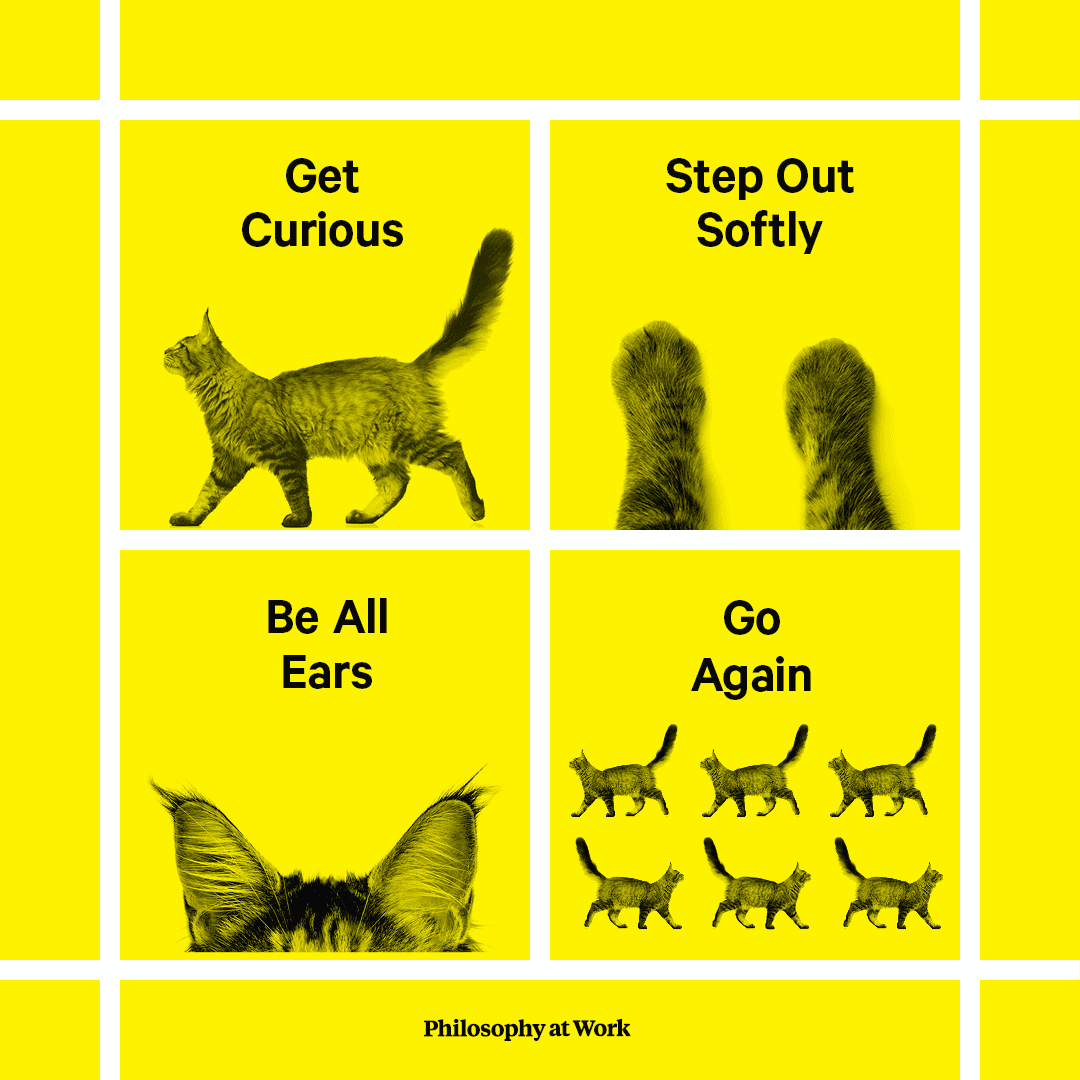
Step 1: Get curious
Having a curious mindset is not a destination. It is a way of approaching things that helps businesses and their people work out what is the best way forward for them. A curious mindset is characterised by engagement and psychological safety — because it’s hard to be curious if you’re disinterested or don’t feel safe.
We think the Stanford Psychology Professor, Carol Dweck, got it right when she said that a mindset is a set of beliefs. A curious mindset starts with the beliefs that not knowing everything is normal, that questions are intrinsically valuable, and that the road to discovery is often paved with mistakes. When beliefs like this inform your outlook, your work is different. Businesses that have developed a curious mindset work like this:
- They care more about getting things right than proving they are right.
- They put good questions ahead of easy answers.
- They keep working on trustworthiness.
As a result, businesses that live in this way generate greater psychological safety, which enables their people to feel safe enough to exercise their curious minds, and that leads to work that is better, more enjoyable and, importantly for this moment in time, more adaptable.
Step 2: Step out softly
When businesses and individuals take a curiosity-driven approach, it’s more likely they’ll view the first phase of transitioning out of what could be called ‘2020 mode’ as a ‘soft launch’. This means: trying out lower risk experiments — think kayak instead of Titanic. Put simply, launching softly produces incremental gains for longer-term wins.
This second step in taking a curiosity-driven approach isn’t new to thinking around innovation. The “Iterate Fast and Release Often” philosophy usually attached to the world of startups, is based on the belief that the perfect product is shaped by the users — that it’s better to launch an MVP (minimum viable product) and test features in the market, then build something no one wants. As Reid Hoffman, the founder of LinkedIn said, “If you are not embarrassed by the first version of your product, you’ve launched too late”.
“If you are not embarrassed by the first version of your product, you’ve launched too late.”
Reid Hoffman
While there are a lot of questions (and potential answers!) about what a business’ MVP should look like in the current situation, if we let go of worries attached to getting policies perfect right from the get go and instead favour iteration, organisations will be more likely to find a solution that works well for them. With so many of our situations changing during the pandemic, it’s never been so important to tread lightly (but boldly!), conscious that our first, second or third attempt will not be as good as our fourth or fifth.
Step 3: Be all ears
It’s no good experimenting if you don’t learn and improve. Therefore, our third step is all about investing time and energy in really listening. This step is all about listening to employees and clients before and during experiments, and it’s about standing back after experiments to ‘listen’ to your data on productivity, employee experience and client satisfaction.
Because real listening is not just about hearing but also taking what you hear on board, ‘being all ears’ involves ultimately learning and changing (i.e. iterating). In this way, over time your way of working will fit your business, your people and your clients like a glove.
An approach that doesn’t come from this place of curious listening, will be more likely to result in situations where policies feel top-down and rigid. Even if a policy is the right one for a business at a given time, if it does not come from a place of listening and response, leaders are missing a significant opportunity. Good answers can be delivered from on high, but doing so misses organisational culture characterised by relationship, engagement and flexibility — things which lead to a decrease in employee happiness and retention over time.
This has been one of our biggest learnings from the last year: doing distributed virtual work is less about the tech you choose and more about the culture you create. So too, the curiosity-driven approach that we’re advocating here is less concerned with the ways of working that you actually choose and build – it’s all about the culture you create as you go about building it.
Step 4: Go again
If your business has adopted a curious mindset, if your people feel safe enough to ask great questions and share ideas, and if you’ve experimented, listened and learned, then you’re ready to go again. That is, you’re ready to adjust your experiment, try again and take another step towards working out your next normal. In fact, you’re able to do better than that! You’ll fly past ‘next normal’ and create a positive and exciting way of working you never would have imagined.
Most importantly: Start now!
More Articles
Power People
and Process
In conversation with Jess Majekodunmi and Dan Kiernan about the intersection of AI and work
Slow thinking with Tom Freeman
In an age of ever-faster tech iterations, what might we gain from practicing slow thinking? In this conversation with Philosophy at Work, Headspace’s Tom Freeman explores tech, wellbeing and intentionality
Be more strategic
Swimming upstream with strategy veteran and Salmon Labs founder, Rob Estreitinho. Dr. Brennan Jacoby and Rob discuss all things strategic thinking.


